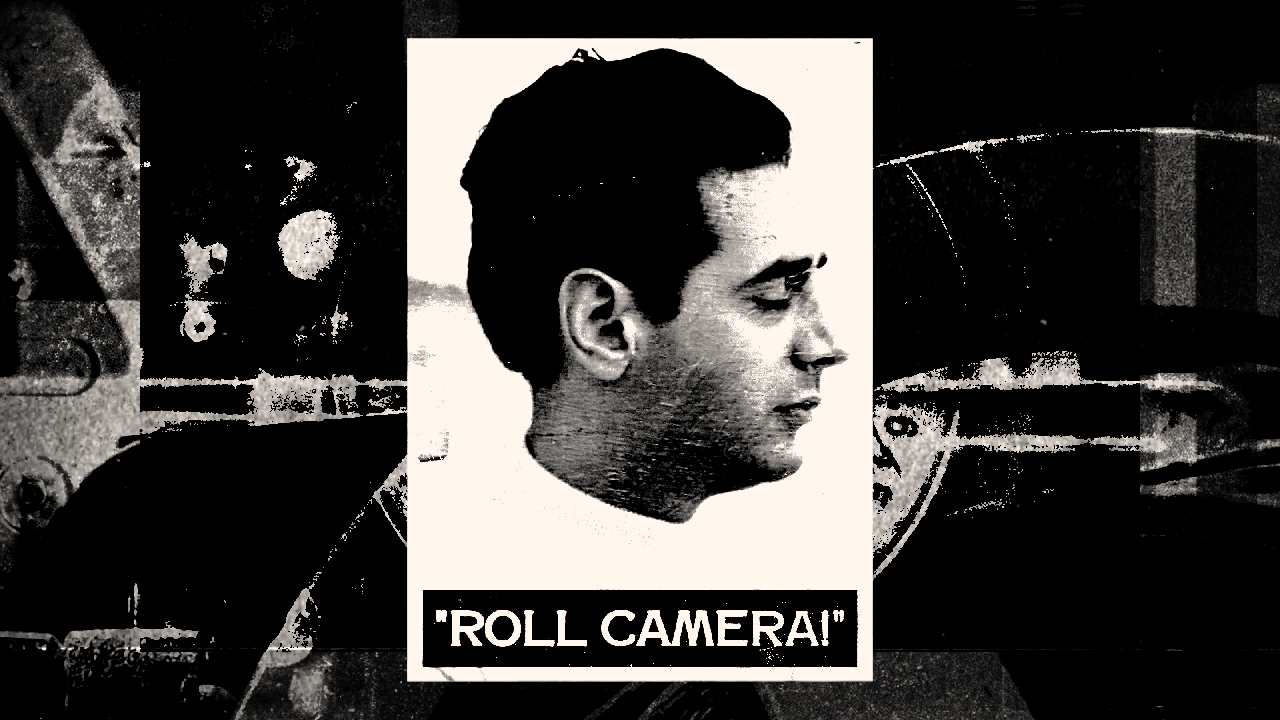
It is hard to say when exactly this obsession startet. But there’s no doubt in my mind anymore that Alex Monty Canawati and I are obsessed. Or should I say possessed? He is possessed by his spirits and I’m obsessed with his story. I conducted my first interview with him in 2010, for an online magazine that no longer exists. The subject of our conversation was „Return to Babylon“, a film about the myths and scandals of Hollywood’s silent film era. A film whose production had already dragged on for several years and that seemed to be slowly driving its director, Alex, mad. My very first question was about how he manages to keep his sanity in the film business. Does he even manage? „I do the best I can“, he told me back then.
We first had met a few years earlier on Myspace. Anyone interested in music, film, and pop culture in the early 2000s could find like-minded people from all over the world there. Alex stood out. It must have been this unique blend of enthusiasm and megalomania that fascinated me. Not least his tall tales about actors from the afterlife, haunted footage, and other mysterious events that supposedly plagued him and his work. The channels and platforms have changed, but we’ve stayed in touch, even though there have been long breaks from time to time. No, I’m not sure when it started, when my fascination turned into something like an obsession. But I’ve collected a lot of material since then – emails, notes, quotes, and interviews. There’s some interesting stuff in there, some of it bizarre and disturbing, frantic messages about Jesus and Mary, Alfred Hitchcock and Rudolph Valentino, and frequently about „Monty,“ his alter ego. There must be something I can do with this, I thought. A portrait, an essay, maybe even an exorcism. Some kind of explanation for what happened to him.
When I finally told him about the idea for this piece, he had already sensed it. With his invisible antennas. In Alex Monty Canawati’s world, there are no coincidences, only signs, messages, and meaningful connections. Everything seems predestined. Even our strange long-distance friendship that has lasted for nearly twenty years now and that has finally led me to make him the hero of his own story. Will I do him justice? Probably not. But I feel I owe it to him. At least to write down what I know. Maybe the truth is hiding somewhere among these notes. Are you ready for your Closeup, Monty?
Part one: Name-dropping
„There’s always a place at the plant for a boy like that.“
from „A Place In The Sun“, 1951
The story begins in a movie theater. With a close-up of Montgomery Clift’s face, in black and white. It’s the opening scene from „A Place in the Sun“, the film that would make him a star, alongside Elizabeth Taylor. These days, Montgomery Clift’s name is rarely found on the rankings of the so-called „greatest actors of all time.“ Yet he was once considered the greatest talent of his generation, the first popular method actor even before Marlon Brando and James Dean. He was said to have a downright hypnotic presence that made his audience forget the line between screen and reality. Is it any wonder then that a young film student named Alex Canawati believed he was no longer the same person after seeing „A Place in the Sun“ for the first time? The year was 1989, the place was the Norris Cinema in Los Angeles. Alex had just turned 20, and „Monty“ Clift has been dead for more than twenty years. But the magic still worked. Perhaps this screening was meant just for him.
Something has rubbed off on him. He can’t get him out of his head; he buys biographies and reads everything available about the actor. A particularly passionate fan, you might think, there are plenty of those, not only at the film schools. But Alex is more than that. In the years that follow, he travels to New York City several times and visits Clift’s former home in Manhattan. He spends hours there, meditating, trying to make contact and follow traces. Possibly his own. Because he is convinced that he is the actor Montgomery Clift reincarnated. Yes, I’m talking about reincarnation here. As a result he even has his name officially changed. Isam Hanna Canawati is what it says on his birth certificate, a name that reveals his Palestinian heritage. Alex is a nickname he had since his school days, together with his new on-screen identity, he now becomes Alex Monty Canawati. He gathers potential evidence, no matter how small the clue. There was the number 512 that always made him nervous, whenever he saw it on a car’s license plate for example. It was on May 12 (5-12) 1956, that Monty Clift was involved in a car accident that would forever change him both physically and emotionally. He sees the name Monty in all his variations popping up everywhere: Montebello, the Los Angeles neighborhood where he grew up, or Montellano Avenue, the street where he lives today. All those places and streets where their paths might have crossed: Montgomery, Montecito, Monterey, El Monte … He’s written them all down.
Yes, you can shake your head. You can call him delusional and send him to a doctor. But you can also just accept it, as I have come to do. It’s impossible to write about Alex without delving into the paranormal as well. Maybe he’s a time traveler or a medium. Or maybe he’s just searching for his identity, his own place in this world. Alex is talkative and outgoing – quite the opposite of the gentle, reserved character Montgomery Clift was known for. What do these two have in common? Monty Clift was gay, a fact he had to keep hidden from the public in his day. Growing up in a conservative family home, Alex also struggled with that specific part of his life. Even though times had long since changed in that regard, at least on the surface. He remained single, surrounded by friends and a revolving cast of acquaintances, but without any truly lasting romantic relationships. A lone wolf, devoted solely to his creativity. It might be the tragedy of a career cut short that connects him to Clift. A talent that is slowly fading from the collective consciousness. Alex knows what it feels like to be forgotten by film history. A place in the sun is never permanent in Hollywood. But I’m getting a little ahead of myself.
So let’s jump back a few decades and address the question: Has Montgomery Clift ever been to New Orleans? He has, according to his biographers. On one occasion, in the 1940s, he is said to have been treated there in a hospital for a mysterious Mexican virus. Alex says it was the same hospital where he was born on August 11, 1969. I can’t tell whether that’s enough to trigger a reincarnation. But for those who believe in such things, there’s hardly a better place than this city at the southern end of the Mississippi River, which is richer in occult traditions and legends than any other place in North America. Psychics, shamans, voodoo priestesses, self-proclaimed witches, and vampire hunters have long been invoking the world of spirits and gods here. In New Orleans, they say, the border between the realm of the living and the dead is particularly permeable.
His parents weren’t too concerned about all that. After all, they had arrived with their own, no less legendary baggage. Both were from Bethlehem in what is now Palestine – the very place where, more than 2,000 years ago, the founder of Christianity is said to have been born. The Canawatis, themselves Orthodox Christians, have a long and extensive family history in the Holy Land. Their roots can be traced back more than 400 years there and in the surrounding areas. Even the current mayor of Bethlehem is a Canawati. The violent occupation of their homeland forced many of them to emigrate in the second half of the 20th century. Today, they are scattered across almost every part of the world, most of them on the American continent. When his first son was born, Dr. Hanna Nekhleh Canawati was still a medical student. He had begun his training in 1964 in Damascus, Syria, and earned his medical degree in 1971 in Chicago. New Orleans was meant to be only a brief stopover for him and his young family. Alex was five years old when they moved to Los Angeles, where they still live today and where Canawati Sr. established himself as a professor of clinical pathology. It was a distinguished career, one he would very likely have wished for his son as well. But Alex had other plans.
He probably would have become a filmmaker anywhere else in the world. It just would have taken a little longer. But as it was, he was chosen to grow up right in the center of a different kind of promised land. One that had given rise to a new breed of gods and legends. Their names were immortalized on the Hollywood Walk of Fame; their artfully lit faces became icons of a new era, adapted each season to the taste of their audiences: Greta Garbo and Rudolph Valentino, Marlene Dietrich and Gary Cooper, Bette Davis and Clark Gable, Bogey and Bacall, Rita Hayworth and Gene Kelly, Marilyn and Jimmy Dean, Liz Taylor and Monty Clift. Generations of young people had been lured to this place with the promise that, with just a little luck and talent, one day they too might rise to join the circle of these immortals. Alex had discovered his love for cinema and its new gods at an early age. A tour to the Universal Studios with his family gave him his first chance to look behind the scenes and marvel at the sets of his favorite movies and TV shows. He was 13 when he saw Alfred Hitchcock’s „Rear Window“ and started to dream of directing his own films one day. Capturing the world in images, working magic with light and music like the old masters. And perhaps becoming one of them, with everything that goes with it – a mansion in Beverly Hills and Oscars on the shelf. After high school, he initially entered the University of Southern California as a civil engineer major, but soon switched to film. In the end, his dream of movie making was more important than pleasing his parents with what they considered a respectable career choice. They were shocked to hear the news, but still supported him when he finally entered the USC’s School of Cinematic Arts, one of the most prestigious and historic film schools in the U.S. And that brings us back to that fateful auditorium of the Norris Cinema, where in 1989 he became „Monty“, the artist and the possessed.
He could not have been be any closer to the Dream Factory. The School of Cinematic Arts has been around since 1929. Some of the most influential figures of the silent film era, such as Douglas Fairbanks, Mary Pickford, Charlie Chaplin, and Ernst Lubitsch, were involved in its founding. Since then, the school has produced legendary movie directors like John Carpenter, James Ivory, George Lucas, and Ron Howard. The campus is located just a few blocks away from the Shrine Auditorium, where many of the Oscar ceremonies were held between 1947 and 2001. Billy Wilder, Barbra Streisand, and Burt Lancaster were among the guest speakers at the lectures Alex attended in the following years. Here he soon found his subject. It was Hollywood itself that would become the focus of his work. Specifically its „Golden Age“ from the 1920s to the 1950s, when moving pictures conquered the world. „They had style, they had grace, Rita Hayworth gave good face“ Madonna sang on MTV just as Alex was starting to explore the history of Hollywood. So he wasn’t the only one looking back. But could the magic of that era really be revived? It was at least worth a try. Why else had Monty Clift been reincarnated?
Was it just a lucky coincidence that he shared a room with the grandson of film composer Alfred Newman during his time at USC? Of course not, there are no coincidences – not in this story. „All About Alfred“ was to be the title of his first project, a documentary about the composer’s life and work. The title was a nod to „All About Eve“, one of the more than 200 films for which Newman had composed the soundtrack. Through the grandson, he quickly made contact with Newman’s widow, Martha Montgomery (there it was again, that name!), who helped him interview other famous film composers and actors. The perfect start it seems. Almost. The fact that „All About Alfred“ was ultimately never completed or released was apparently due to unresolved music rights. Were there other reasons? In any case, the film remains hidden away in the archives to this day. For Alex, it was a foretaste of the pitfalls of the industry. But he was just getting started, full of drive, and making valuable contacts. Some of them seemed almost too good to be true.
His next project was also going to be about an Alfred. This time it was Hitchcock, the Master of Suspense whom he had admired since childhood. At the USC Alex had already shot two short films that were influenced by Hitchcock. By now he had earned his degree in film production and could hardly wait to tackle his first feature film. „Inevitable Grace“ was its name, a psychological thriller based on his own screenplay, interwoven with motifs from films like „Rear Window“ and „Vertigo“. And with a real Hitchcock star in a supporting role: Tippi Hedren, the lead actress from „The Birds“ and „Marnie“. I asked Alex how he’d managed to pull that off. „I just called her“, he said. So that’s how it worked in Hollywood. Every door seemed to be open to the talented and charismatic newcomer.
There’s a photo from the film’s premiere in February 1994 showing Alex next to Tippi Hedren, smiling with wide-open eyes, as if he could hardly believe his luck. Mrs. Hedren, on the other hand, looks at him somewhat mockingly from the side. „If only you knew what’s in store for you“, her gaze seems to say. I may be reading a little too much into this. In hindsight, of course, pictures can always be interpreted quite differently. Only a few reviews were published after the premiere and they were scathing. „Amateurish“ was one of the kinder terms used. I, too, was able to see the film, much later and online. The visuals were spot-on, that much I can say. Alex had studied Hitchcock well, some shots seemed to have been taken straight from the master himself. „Inevitable Grace“ certainly doesn’t lack references. Key scenes were shot at the historic Rialto Theater in Pasadena where classic movie posters are seen in the background. Hollywood history is referenced everywhere, including the cast: Next to Hedren, there is Maxwell Caulfield as a sexy take on James Stewart, also Jennifer Nicholson (Jack’s daughter) and Jaid Barrymore (Drew’s mother), Andrea King (once a colleague and rival of Bette Davis), Taylor Negron and Samantha Eggar, to name just a few. Promising ingredients. But the result? I have to be honest here: It’s hard to take the plot even remotely seriously. What is this, I wonder. A satire? A soap opera? Or perhaps a surreal masterpiece that I just haven’t grasped yet? There is an idea, a sort of central theme, at least: A naive psychiatrist falls for the mysterious husband of one of her patients and apparently loses her mind. She falls into an identity crisis, briefly becomes a lesbian, then a murderer, and finally Kim Novak and, at least visually, Grace Kelly as well. Unfortunately, however, very little grace shines through the wooden performance of the young lead actress. She isn’t the only problem, though. Almost all the characters act so implausibly, stereotypically, absurdly, and at times unintentionally comically that by the end I wasn’t sure if Alex had been serious about the whole thing.
„What are you trying to do? Wake the dead?“ Jade Barrymore asks in one scene. That was it, I guess. A summoning. His first attempt to revive the past. A cinematic séance, pieced together from quotes and symbols. Interpreting these can actually be fun, once you’ve given up all hope of a coherent plot or screenplay. There are individual scenes that work on their own. Little sketches that could have become something more. In character, Tippi Hedren directly references her real life, troubled relationship with Hitchcock: „He must have been obsessed. He had a thing for blondes“, she says. Monty Clift also haunts the story. His photo appears in the apartment of Maxwell Caulfield’s character, who, by the way, talks like a caricature of an English aristocrat throughout the film. When he (for reasons unknown) ambushes the stressed-out young psychiatrist in the middle of the day in an empty movie theater, „A Place in the Sun“ is playing. Something about this story felt familiar: A woman with multiple identities, symbolized by the change in her hair color, repressed fears and erotic obsessions, reflected in dreams and film-within-a-film sequences. I had to think of David Lynch. He had worked with similar motifs, though not until years later, in „Lost Highway“ and „Mulholland Drive“. Lynch was known for using transcendental meditation to support his creative process, essentially searching the collective unconscious for new ideas. Who inspired whom? In the end, both reference Hitchcock’s „Vertigo“.
Drawing inspiration from the past without creating a second-rate copy is a challenge for most young filmmakers. Alex was just 22 years old when he started filming his debut. Much older and more established directors have fallen short in the face of Alfred Hitchcock and his towering shadow. Take Brian de Palma, for example, another self-proclaimed fan of Hitchcock, who created two rather controversial reinterpretations in the 1980s with „Dressed to Kill“ and „Body Double“. The latter starred Melanie Griffith, Tippi Hedren’s daughter. Or Gus Van Sant, whose remake of „Psycho“ turned out to be a major flop a few years later. How would Hitchcock himself have commented? It would be years later when his spirit would make itself known to Alex. In recent months, he started posting screenshots of „Inevitable Grace“ again. It is the story of a reincarnation, he claims. It might very well be. He would know best. The film is part of his personal mythology. At its center has always been – and still is – Monty. Clift and Canawati.
What could have been be more obvious, at this point, than attempting a remake of „A Place in the Sun“? The idea seemed truly inevitable. There were plans, preparations, a screenplay. The story was to be reimagined for the 1990s as „Deep in the Heart“, with none other than Robert Downey Jr. in the lead role. Remakes of old films had always been a popular way to reach a new audience with old material. „A Place in the Sun“ itself was an adaptation of Josef von Sternberg’s „An American Tragedy“ (1930). However, it was one that clearly outshone the original. Could Alex really have measured up to that? We won’t know. It wasn’t meant to be, since the scandal-plagued Downey Jr. was once again stumbling back and forth between rehab facilities and jail. Preparations stalled, and the whole thing was quickly forgotten. Alex still wonders sometimes what course his career would have taken if the stars had aligned in his favor back then. Another famous name – would it really have made a difference? He still owns the rights to his screenplay. So the story might someday be brought to life after all.
Giving up is not an option in Hollywood. Cancellations are normal. Being rejected and disappointed, waiting – it’s all part of the deal. It is a gamble, a sometimes nerve-wracking test of patience. Those who can’t handle it leave the industry after a few years. Everyone else keeps going, tries to survive or goes mad – sometimes all at the same time. Former stars and self-proclaimed future starlets, in search of fame and validation, that was now his company. So he made a film about it: „Citizens“ – a loose collage about the chaotic daily lives of young actors amid auditions, prostitution, and drug habits. The infamous flip side of Hollywood. There was no shortage of inspiration, nor of contacts. It was the financing that became more and more of a problem. Necessity is the mother of invention, so he learned to improvise. Being „amateurish“ was now intentional, a stylistic choice inspired by Andy Warhol’s experimental films of the 1960s. He even managed to recruit some of Warhol’s original „Superstars“ for the project: Joe Dallesandro, Holly Woodlawn, and Udo Kier. And of course Alex Superstar Canawati himself in a central role. Everyone here seems to be playing themselves: „I’m sick of my career going down the tube“, „We should make our own movie“ – lines from the film and apparently from the personal lives of its protagonists. Whatever happened to „Citizens“? There is a movie trailer, not much more. An unfinished project, like so many from that era.
The next millennium was approaching, and Alex had already grown accustomed to working on his own. Being free and independent isn’t a bad situation, in principle. But how does one attract the attention that every artist ultimately and desperately needs? He wouldn’t be able to do it alone. Help from the beyond was needed. From the past, where he had already been searching for inspiration. He was heading in the right direction, he just hadn’t traveled back far enough yet.
Part two: Ghosts
„Drama, a city full, tragic and pitiful“
Don Blanding, „Hollywood“,1928
We need to go back a few more decades. To the beginning of the Golden Age. More precisely, to the morning of February 2, 1922, when Los Angeles woke up to a news story that would send shockwaves through the film industry and the rest of the country: William Desmond Taylor had been found murdered in his apartment in the Westlake Park District. The circumstances of the crime soon proved to be just as strange as the victim’s life story. In the coming weeks, readers of the American press would be extensively informed about it all. At the time, William Desmond Taylor was one of Hollywood’s most famous figures. As a director, he had shot more than fifty silent films for the Famous Players–Lasky Corporation (the predecessor of Paramount Pictures). As president of the Motion Picture Directors Association, he was also something of a figurehead for the entire industry, which could not have invented a more spectacular drama for the silver screen. It involved a victim with a mysterious past, a film producer (Adolph Zukor) who was more powerful than the chief of the Los Angeles police, cover-ups, blackmail, and secret affairs. It also involved a list of suspects that grew longer and more outlandish over time. Among them were numerous well-known actresses like Mabel Normand, who had visited Taylor the night before. A former assistant on the run, various gangsters, drug dealers, and members of a mysterious homosexual opium cult were also on the list. And it all revolved around a murder case that remains unsolved to this day.
More than 70 years later, Alex was walking along Hollywood Boulevard. It was the eastern, less spectacular part, at the corner of Normandy Avenue. What had driven him there that day is hard to say. In any case, according to legend, it was right there that he and a friend found a bag of black-and-white film stock, brand-new and sealed. A total of 19 rolls, in perfectly usable condition. Someone had discarded them there. Or left them for an out-of-luck filmmaker in search of inspiration and support. Alex had been carrying around the idea of shooting a silent film in the style of the 1920s for quite some time. The unexpected discovery reignited that idea. He had found the film reels on a Tuesday and began shooting the following Saturday, together with a group of friends, actors, and extras he’d spontaneously rounded up. By then, he’d become quite good at improvising. The William Desmond Taylor murder case was the perfect subject. A classic true-crime drama, set right in the heart of Tinseltown. Astonishingly, the story had not been made into a film until then. Curtain up for „The Birth of Babylon“, a short film just under 18 minutes long, shot in a single weekend on a budget of 800 Dollars, which revived not only Hollywood’s scandalous early days but also its director’s faith in his own talent.
Silent film is cinema in its purest, most original form, as Alex repeatedly emphasizes. With „The Birth of Babylon“, he went to the roots of his art. It took only a few short scenes to bring William Desmond Taylor and his era back to life. Grainy black-and-white images, accompanied by piano music and punctuated by the typical intertitles. It is evident how much the actors enjoyed their improvised performances and exaggerated facial expressions. Alex himself played one of the detectives investigating the murder of William Desmond Taylor. The film ends with a reenactment of the frivolous opium and cocaine parties for which Hollywood was already notorious in the 1920s. Parties, whether with or without „snow“, had always been essential for making connections. Alex was good at networking, and probably at partying, too. It might have been one of the reasons why his small-budget – or rather, „no-budget“ – film suddenly garnered so much attention. In October 1999, he celebrated the premiere of „The Birth of Babylon“ at the legendary Sunset Tower Hotel. Less than a year later, he won the award for Best Short Film at the independent AFFMA Film Festival in Los Angeles. For Alex, this was a clear sign that he was on the right track. He was additionally encouraged by actress Maria Conchita Alonso, who asked him (at a party, naturally) about a possible sequel. Wasn’t there a part for her in another silent film? There was: Lupe Velez, the Mexican diva of the 1920s and 1930s, whose energetic movie roles were surpassed only by her scandalous private life. Just one of many personalities and stories that offered themselves to pick up where „The Birth of Babylon“ had left off.
Celluloid Babylon – that’s how the poet Don Blanding had referred to the movie capital in 1928. Drawing on the biblical model of Babylon, the „Mother of harlots and of all the abominations of the earth,“ Hollywood had been associated with this image since its earliest days, when a handful of entrepreneurs experienced a new gold rush under the California sun. Suddenly, there was a lot of money to be made with moving pictures. A type of celebrity emerged that was both admired and frowned upon: movie stars who became millionaires overnight and seemed to exist outside the bounds of decency and morality. It was the era of sex, drugs, and the Charleston; cinema became the idol of mass culture, and the church ladies of America were alarmed. Before the introduction of the Hays Code in the 1930s, film studios were still able to operate free of any censorship, and thus could depict anything that conservatives considered taboo. Hollywood versus the Bible Belt, hedonism versus Puritanism – the culture war continues more or less to this day. But it wasn’t just the events on the screen that disturbed the puritans. The private lives of the movie actors constantly provided new headlines that threatened to undermine public morality – and which the public, for that very reason, couldn’t get enough of. When news of the murder of William Desmond Taylor spread in 1922, Adolph Zucker already had several scandals to manage. Just recently, the case of Rosco „Fatty“ Arbuckle had caused a nationwide sensation. Arbuckle, one of the highest-paid movie stars at the time, had been charged with rape and murder. After several trials, he was ultimately acquitted, but his career was over. And the studios found themselves facing increasing demands for censorship. Decades later, Kenneth Anger revived many of these early scandals in his book „Hollywood Babylon“. He wasn’t always a reliable narrator though, mixing facts with fiction and rumors, and spicing them up with his own occult ideas. It was in this rich trove of weird tales and tragedies that Alex found his material for „Return to Babylon“.
The William Desmond Taylor story he had shot for „The Birth of Babylon“ now became the starting point for a series of additional episodes. There was no shortage of illustrious candidates to play the new parts. Alex was still extremely well-connected, better perhaps than ever before. He was able to cast Jennifer Tilly as silent film star Clara Bow, Debi Mazar as Gloria Swanson, and Maria Conchita Alonso as Lupe Velez. Laura Harring, who simultaneously was starring in David Lynch’s „Mulholland Drive“, was given a brief scene. And Tippi Hedren returned to portray Mrs. Peabody, Adolph Zukor’s secretary – another Hitchcock reference since „Mrs. Peabody“ used to be the working title of Hitchcock’s first, unfinished work from 1922. When it came to casting, Alex seemed to have almost free rein; he even had to turn down some A-list actresses who were interested in joining the project. He must have felt like the king of Babylon back then, while still being independent, without big money or studios backing him. The budget might have been more than 800 Dollar this time, but most of the people involved were still willing to work for little or no pay. Maria Conchita Alonso and others stepped in as producers. It was a labor of love, held together by faith in an idea and its enthusiastic director.
„Return to Babylon“ begins with a gaze into a crystal ball. „Behold the tale of souls who lived and died, worked and played, rich or poor, forever shadows on the Silver Screen“ one of the first intertitle reads. The crystal ball serves as a link between the episodes while also hinting to their somewhat fairy-tale nature. Alex, too, had to take some liberties in telling these stories. Who really knew what exactly went on back then at Clara Bow’s wild parties, in Lupe Vélez‘ marriage to „Tarzan“ Johnny Weissmuller, or when cocaine-addict Alma Rubens finally lost her mind? It was about capturing a mood, improvised and comedic. This time it was to become a feature-length film. Finishing it would prove to be much more challenging than he could have anticipated. It took nearly three years shooting all the scenes he needed. The episodic structure allowed him to continue whenever actors and locations were available.
Where was Monty Clift at that time? There wasn’t much room for him in the world of silent cinema, it seemed. Alex had replaced his alter ego with Rudolph Valentino, at least temporarily. For „Return to Babylon“, he took on the role of the legendary Latin Lover himself and was even able to use Valentino’s former Beverly Hills home, „Falcon Lair“ as one of the locations. Appearing in his own films had become a habit for him. There may have been practical reasons (one less actor he had to look after), but it was certainly also due to his vanity. At the same time, he was, consciously or not, continuing a certain tradition. The first filmmakers, the pioneers of early silent cinema, still had to invent their profession; they often served as directors, cinematographers, and even actors all at once.
Haunted celebrity mansions are part of Hollywood folklore, and Falcon Lair was particularly notorious in this regard. Rumors of ghost sightings began to circulate shortly after Rudolph Valentino’s death in 1926. Several tenants soon reported hearing voices, creaking stairs, and other strange noises. Later, one of the caretakers was found responsible for the hauntings. He was a hobby spiritualist who held séances which he liked to enhance with homemade electronic devices. Nevertheless, the rumors continued, and they surely didn’t stop while Alex and his crew were filming there. If anyone should have sensed Valentino’s ghost, it surely would have been Alex himself. But it was mainly the other actors and members of his team who began reporting eerie experiences. Cold drafts, invisible hands, voices and shadows, the sense of a presence – in other words, the whole repertoire of undead souls. Valentino’s mansion wasn’t the only former celebrity home where filming took place. There was plenty of space and opportunity for their spirits to make themselves known. „Behold the tale of souls who lived and died“ …
By 2003, the final scenes had been shot, and Alex set about the tedious process of post-production and editing. There are different explanations for what he discovered during this process. Morphings is what he calls it – single frames suddenly showed strange and unexpected changes; actors’ faces and limbs appeared grotesquely distorted. Objectively, these could have been purely technical issues. „Return to Babylon“, after all, was shot with an old hand-cranked camera and black-and-white film, the speed varied between 16 and 18 frames per second. When transferring the film negatives to the standard 24 frames per second and later to a digital format, many of the individual frames were artificially stretched. However, some of the visual distortions seemed so bizarre that Alex began to see more in them: demonic faces, vampire-like figures, hands that turned into monstrous claws. The footage seemed to take on a life of its own. Alex insists that none of this was intentional. On the contrary, several experts had examined the material and were unable to find a reasonable explanation. The more he analyzed these frames, the more he discovered. Not just distortions, but entirely new images – shadows, figures, and faces. What if not only the locations were haunted, but the film itself? In cases like this, the audience is usually divided into believers and skeptics. I happen to find myself somewhere in the middle, wavering back and forth between both sides. Isn’t it true that we tend to see exactly what we want to see? A face in a cloud, for instance, where others see only a cloud? In that sense, „Return to Babylon“ has become a kind of cinematic Rorschach test: gaze into a crystal ball and tell me what you see! Alex has compiled still images that are supposed to prove the paranormal influence on his film. Some of it does indeed seem eerie, I must admit, and cannot be explained away by blurriness or any conventional distortion. Whatever caused these morphings, they were to become part of the finished film.
It was 2007 when I first became aware of Alex on MySpace. By then, there were already several edited versions and trailers for „Return to Babylon“. According to imdb.com, the film had been in post-production for more than three years. The reasons cited for the delay were the morphings and paranormal phenomena that Alex and his team had discovered and which he was now readily discussing in the media. The film did not have a distributor, but its release was scheduled for 2008. Thanks to its prominent cast, the story even briefly made its way into the mainstream. Jennifer Tilly shared her experiences on set during her appearance on Jay Leno’s Tonight Show. Later, an entire episode of the Biography Channel’s „My Ghost Story“ was devoted to the making of „Return to Babylon“. In the episode, Maria Conchita Alonso and singer and actress Morganne Picard (who had starred in the role of Mabel Normand) talked about how Alex had changed during filming. They actually called it his possession. He seemed even more eccentric than ever, they said. Alex himself also made an appearance and indeed came across a bit erratic and somewhat unhinged. „I was accused of making a pact with the devil“, he said with wide-open eyes. They are the same eyes you can see on that photo from 1994, but his look is no longer the same. Something has changed; the previous decade has clearly left its mark.
Maybe the devil could have simply be called stress. Constantly working on the brink of bankruptcy, uncertain whether the project will ever be finished – who wouldn’t lose their last nerves? In times like these, a desperate filmmaker might well resort to unusual methods to draw attention to himself. It’s all about attention and recognition, after all. No one wants to be overlooked or forgotten. So there were accusation of a hoax of course. But at least, people were talking about him. Over time he became part of Hollywood’s dark folklore. From discovering the film reels on Hollywood Boulevard to Valentino’s haunted house and those strange morphings – you didn’t necessarily have to believe in ghosts to be captivated by this story. Alex has told it countless times since then, caught in an endless loop of questions and mysterious hints. Was he chosen to receive messages from the afterlife? What did these messages mean? „I was attracted to doing a film about Hollywood tragedies because I was one myself“, he told me once. I couldn’t have said it better.
2008 came and went, and a potential release date was pushed to 2011. A friend and colleague, filmmaker Matt Riddlehoover, helped him edit a new version that ultimately included a compilation of all the infamous paranormal scenes and stills, as bonus material. It was this version that Alex sent me on DVD, and we exchanged several emails about it. The final version, however, was not edited before 2013, with the help of another friend: Stanley Sheff, a.k.a. „Maxwell DeMille“, who played Douglas Fairbanks in „Return to Babylon“. Like Alex, Maxwell DeMille is a lover of Hollywood’s Golden Age. He had worked with Orson Welles in his youth and still regularly hosts retro parties at „Club Cicada“ in Los Angeles. That’s where the premiere finally took place on August 11, 2013 – ten years after filming wrapped and just in time for Alex’s 44th birthday. It was the same club where scenes for the Oscar-winning silent film „The Artist“ were also shot. Alex likes to emphasize that it was actually he who initiated the silent film revival. He was first, that is true. It should also be pointed out that „Return to Babylon“, in comparison, looks much more original and authentic. Unfortunately, it didn’t receive the same kind of support as „The Artist“, who had none other than Harvey Weinstein as its powerful backer.
But Alex enjoyed a different kind of support. One of the guests invited to the premiere was a great-nephew of Rudolph Valentino named Giovanni Guglielmi. Alex had just recently met him. „By chance“, I almost added. But we know better – there are no chances, it simply had to happen. Guglielmi gave him a ruby ring that had belonged to the Valentino family. Alex later took this ring to a psychic who, charged with its energy, immediately made contact with Rudy Valentino. Alex had come to fully trust the powers of the paranormal at this point, and had concluded that he himself was in fact clairvoyant. And what can I say – the longer I spend time with his story, the more I, too, now see connections that I might not have noticed otherwise. Does that make me clairvoyant? I don’t think so, but it does make me more observant. For example, I’ve noticed that Rudolph Valentino’s grave is numbered 1205. If that’s not the reversal of 05-12, the fateful number that marked Montgomery Clift’s car accident. I don’t feel any cold drafts or invisible hands yet, but it can’t be long!
If you asked me, the film doesn’t really need all the paranormal hype surrounding it. It works very well on its own – as an entertaining, tongue-in-cheek tribute to a long-forgotten era of Hollywood that was no less wild and wicked than all the controversies and scandals of our time. The fact that it was completed at all was perhaps its greatest achievement. After its 2013 premiere, there were a few more screenings; since then, the film has only been available on YouTube. There’s a website and a terrific slogan: „Return To Babylon – The Silent Movie screaming to be heard!“ That’s about it. I could end my story here. But it’s not that simple, of course. It is too closely tied to Alex himself, not just the filmmaker, but the person. And he’s far from finished. The case remains open, unsolved like the murder of William Desmond Taylor.
Part three: The King of Babylon
„It’s not me that makes the decision.
It tells you when it’s finished. You don’t tell IT!“
Alex Monty Canawati, 2004
What’s missing? A look behind the scenes, I guess. Not too long ago, I came across this Canadian documentary called „Camp Hollywood“, released in 2004. It portrays the residents of the Highland Gardens Hotel at the foot of the Hollywood Hills. Young actors hoping for a job, a chain-smoking writer, a former bank robber, illustrious and stranded characters of all kinds. And right in the middle of it all, Alex shows up – introduced only as „Monty“ – busy shooting the final scenes for „Return To Babylon“. It’s not a particularly flattering appearance, though a very entertaining one. He seems even more manic and obsessed than on his „My Ghost Story“ episode, almost like a parody of an egomaniacal film director. Was he playing a part here? These scenes, the whole „Making Of“, would definitely have made for a great reality show. „Monty on the Brink of a Nervous Breakdown“, it would have been called. „Everyone says Monty is on drugs“, he says agitated at the end, „Believe me, I’ve never stuck a needle in my arm!“ At that very moment, the camera zooms in on a bowl of syringes. „Whose are these?“ he asks. Well, yeah, whose are they, Alex?
Is there anyone ever really sober in „Camp“ Hollywood? Without a little help from powders, shots and pills, uppers and downers and whatever else is available, no one has lasted here for very long. That was, after all, what „Return to Babylon“ was about – this vicious cycle of fame, addiction, and downfall. If you weren’t already crazy, you’re guaranteed to go mad here. That is, if you survive. That’s more or less how Alex himself described it in an interview with Skip E. Lowe, the legendary Hollywood gossip insider who passed away in 2014. „Skip E. Lowe Looks at Hollywood“ was the name of his quirky talk show, in which he interviewed actors and filmmakers outside the mainstream for more than thirty years. Not surprisingly, he too became part of Alex’s colorful circle and made a brief appearance in the unfinished „Citizens“.
At the Highland Gardens, Alex had stayed in room number 206. Just one of many hotels, motels, bungalows, and temporary residences where he would spend the next couple of years. It was in a small house in Ojai, northwest of Los Angeles, where he had discovered the first morphings in his footage. And it was during this time that his visions began. Lights, voices, apparitions. They accompany him to this day, appearing sporadically, speaking to him, guiding him, sometimes taking over. In January 2004, he recounts, a beam of light struck him on the roof of a house on Melrose Avenue. A divine power, what else? This, he said, happened to him several times. These days, he regularly sees himself surrounded by floating lights, a form of spiritual energy. Sometimes, however, the visions take on a more concrete form. Once he saw Jesus, Rudolph Valentino, Charlie Chaplin, and the MGM lion together in a neighbor’s front yard. Valentino winked at him. Near Montgomery Street, in the Downey neighborhood. Valentino, Montgomery, Downey – even to me, that sounds almost like a holy trinity. The Virgin Mary has appeared to him as well, along with the spirits of Alfred Hitchcock and Walt Disney.
Alex knows how all that must sound to others, how quickly people might doubt his sanity. He is well aware of it. But those who are chosen simply cannot worry about such mundane things as mental health. It’s about interpreting the visions and transforming them into something like art – even if it’s just the art of survival. Persevering and finding meaning in the chaos. There were hospital stays, confrontations, and probably a few nights in jail as well. And every now and then, there were manic posts on Instagram and Facebook. Confusing puzzle pieces of a biography that I could only perceive in fragments and from a distance. Sometimes I used to worry. Whenever another one of those emails arrived with a photo that was supposed to show the Virgin Mary, but in which I could make out nothing but a shapeless reflection of light. With photos of crystals and street signs, names and messages. That’s just part of it. I accepted it, like the story of his reincarnation. After all, what do I really know about this world he conjured up? One thing I know for sure: We all have differently tuned antennas. Some of us can receive frequencies and energies that remain closed off to others. Even if they sound like a Hollywood fever dream on LSD. A confused script that’s been rewritten too many times. Or like a remix of „Hotel California“ on repeat: „You can check out any time you like, but you can never leave!“ Bette Davis is talking to him? Joan Crawford? Valentino, Disney, and the Holy Spirit? Okay, no problem. Don’t I hear voices myself? „Write it all down,“ these voices whisper, „no matter how absurd or unfinished it may seem to you. As long as the story gets out into the world!“ Nobody wants to be forgotten.
Hollywood, Babylon, Hotel California – whatever we want to call this strange place, madness has always been a part of it, just like the palm trees, the drugs, and the worn-out Walk of Fame. Its myth is fueled above all by those whose dreams never came true. All the hopeful talents who fail just one step away from their big break, who remain in the shadows, who despair, go mad, and yet still can’t leave. Most of them are never heard of; some only achieve a little bit of fame through their suicide. In 1932, actress Peg Entwistle threw herself from the famous Hollywood sign, and for that reason alone she still lives on in popular culture. You need to make the right impact, no matter how brief it may be. The whole town is a graveyard of zombie starlets, wannabes, and has-beens. No wonder it is haunted. The movies have long explored this haunting theme, though probably never as brilliant and self-referential as in Billy Wilder’s 1950 film „Sunset Boulevard.“ Here, former silent film actress Gloria Swanson stars as the fictional silent film diva Norma Desmond, who, decades after her glory days, fantasizes about a comeback that will never happen. „There’s nothing else. Just us and the cameras and those wonderful people out there in the dark!“ she proclaims, before dramatically striding down the stairs in that famous scene and, now finally succumbing to madness, merging with the camera and her audience.
What exactly were the spirits meaning to tell Alex? Were they trying to warn or encourage him? Is he still on the right track? Or will he end up like Norma Desmond? „Return to Babylon“ remains his last completed film to this day. It does appear on a list of the „most haunted movies“, at least – the folklore survives. And he remains the only director, next to Alfred Hitchcock, to have cast Tippi Hedren in two of his films. A legacy no one can take away from him. To the industry, however, he is at best a statistic, an obscure footnote. No producer has ever really made money with him – a mortal sin in Babylon. Here, you are only as hot as your last project and its box office. His contacts have dwindled over time, the circle got smaller. Even the most well-meaning actors and colleagues eventually moved on to more lucrative adventures. Lately, he’s been telling his story mostly on ghost hunter and alien podcasts. Wherever there is still an audience, „those wonderful people out there in the dark!“ I can’t say whether he’ll ever make another film, no matter how small or independent the production. The world of moving pictures has changed dramatically. It has never been easier to bring your own creative ideas to life and share them with the world. But it also has become louder and more chaotic. Everyone is clamoring for attention – stars, starlets, and self-promoters, Citizens of the digital age.
No, he hasn’t given up on his dream yet. The superficial world of franchises and blockbusters that sustain what’s left of Hollywood today, has never been a place for him. It’s beneath the surface, where he reigns – in the dark underworld, where the ghosts of the past roam and secrets lie buried. Here, he will likely outlive them all. Neither time nor money matters here. Out of this realm the grand inevitable finale will appear, I can see it clearly now: „The King of Babylon“, part three of the trilogy. It will be the story of a movie director who works on a silent film and loses his mind over it, told partly biographical, partly hallucinated. Maybe there are still a few of those old film reels left. Our hero will be embodied by a charismatic actor, preferably still unknown, in his late twenties to late thirties. He should have dark curly hair and big, expressive eyes. A promising talent who is ready to push his limits. Someone open to improvisation and divine inspiration. Most of the locations won’t cost anything – Hollywood Boulevard, Melrose Avenue, Montgomery Street, back alleys, and cemeteries. Surreal scenes are conceivable there. He might even turn water into wine, on the beach, right in front of the ruins of Malibu. Isam Alex Monty Rudy Superstar Canawati, the visionary genius, the paradoxical messiah, perhaps the last great dreamer of this once beautiful promised land. There’s never been a character or a story like this. Yeah, I know how that sounds. Possession is contagious.
First of all, however, there will be a documentary – a real one, not a hallucination. Around the same time I decided to write about Alex, Matt Riddlehoover began filming „Monty and the Movies“ (the current working title). He has conducted numerous interviews with Alex, his friends and former colleagues. Previously unreleased footage is promised. Footage that wasn’t yet available to me. But that doesn’t matter. Each one of us tells this story as we understand it. „Monty and the Movies“ is currently in post-production; there is no specific release date yet. But it can’t be long now. Unless, of course, during the editing, the footage takes on a strange life of its own. I wouldn’t be surprised.